111.09.150.182 IP Address Lookup: Location, Network Details, and Security Analysis
If you have encountered 111.09.150.182 in a browser, website analytics report, server log, firewall alert, or search query, you may want to know what it represents and whether it is safe.
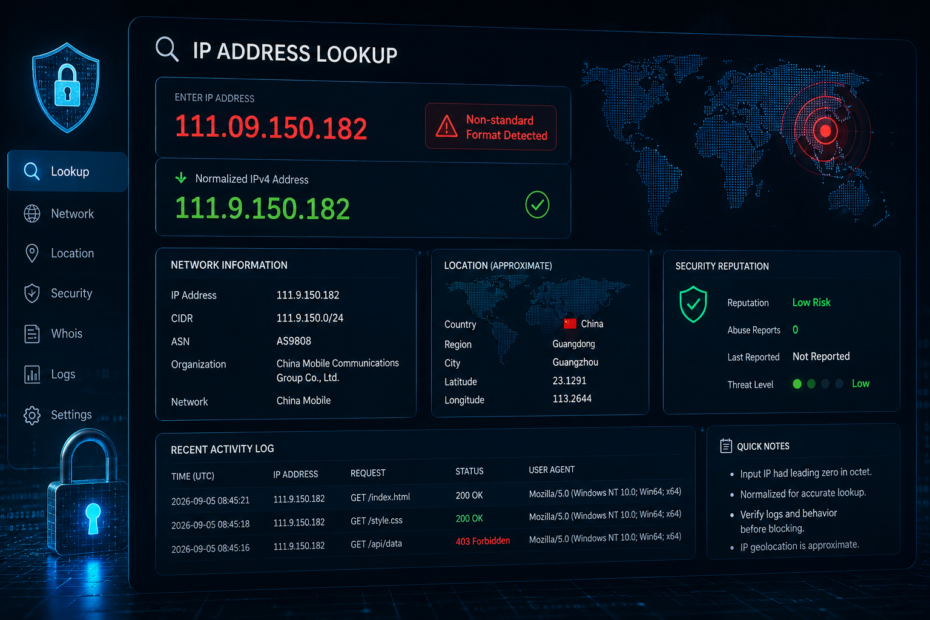
There is an important detail to understand first: the string 111.09.150.182 uses a leading zero in the second IPv4 octet. Standard IPv4 dotted-decimal notation does not use that form. In practical IP research, it is therefore useful to distinguish the exact string someone entered or recorded from the normalized address 111.9.150.182. RFC 3986 also warns that different software can interpret unusual IP formats differently, which can create security and filtering problems.
Current IP-range information from IPinfo shows 111.9.150.182 inside the 111.9.150.0/24 range associated with AS9808 and China Mobile Communications Group Co., Ltd.
That does not, by itself, prove that the address is malicious. An IP lookup is only one piece of a broader network-security investigation.
What Is 111.09.150.182?
The string 111.09.150.182 appears to represent an IPv4 address. IPv4 addresses normally contain four decimal octets separated by periods.
However, the second octet is written as 09 rather than 9. Standard IPv4 literal syntax defines decimal octets without this leading-zero representation.
For practical research, the normalized form is therefore:
111.9.150.182
This distinction matters because different applications and libraries have historically handled non-standard IP representations differently. RFC 3986 specifically notes that some implementations have accepted alternative dotted formats and that this can become a security concern when applications make access-control decisions based on the textual representation of an address.
If you found the original string in a log, preserve the original value for investigation, but also check how your logging, firewall, DNS, or application software normalizes it.
Is 111.09.150.182 a Valid IPv4 Address?
Strictly speaking, 111.09.150.182 is not the standard dotted-decimal IPv4 literal form.
The corresponding conventional representation is:
111.9.150.182
This does not automatically mean that the original string is malicious. It may simply have been formatted by a website, application, script, database, or user.
The important security lesson is that applications should normalize IP addresses before performing allowlists, blocklists, comparisons, or other security decisions. RFC 3986 notes that unusual IP representations can produce differences between software implementations.
What Do We Know About 111.9.150.182?
Current IPinfo information places 111.9.150.182 in the 111.9.150.0/24 network. The range is associated with AS9808, China Mobile Communications Group Co., Ltd. IPinfo also shows the broader BGP allocation as 111.9.144.0/20.
This information tells you about the network responsible for announcing or operating the address range. It does not identify a particular individual using the address.
IP ownership and IP usage are different concepts. An internet service provider can operate a large address range and dynamically assign individual addresses to customers, devices, services, or network infrastructure.
What Is the 111.09.150.182 Location?
If you are searching for the 111.09.150.182 location, first normalize the address and investigate 111.9.150.182.
Available range information associates 111.9.150.182 with a network operated by China Mobile. That provides useful country and network context, but it should not be interpreted as the precise physical location of a person or device.
IP geolocation is inherently approximate. MaxMind explains that IP geolocation is designed to associate an address with a probable geographic region rather than reveal a precise household or street address. Accuracy can also vary according to network type, country, ISP practices, mobile connectivity, VPNs, and other factors.
Therefore, an IP lookup result showing a city or region should be treated as network-location information, not proof of where an individual physically lives.
Can an IP Address Reveal Someone’s Exact Location?
Usually, no.
An IP address can potentially provide information such as:
- Country or region
- Approximate city
- Internet service provider
- Autonomous System Number (ASN)
- Network range
- Reverse DNS information, when available
- Hosting, proxy, or anonymizer indicators from some databases
It generally cannot establish a person’s exact home address simply from the IP.
MaxMind specifically states that its GeoIP data is not precise enough to identify a specific household, individual, or street address. It also notes that VPNs and proxies can cause the lookup to identify the intermediary server rather than the end user.
This is one of the most important limitations to remember when conducting an 111.09.150.182 IP lookup.
Is 111.09.150.182 Dangerous?
There is not enough evidence from the IP address alone to label the normalized address as malicious.
An unfamiliar IP can appear in logs for many ordinary reasons, including:
- A visitor accessing your website
- A mobile or broadband customer
- Automated application traffic
- Search-engine or other crawlers
- API requests
- Network diagnostics
- A proxy or VPN
- Shared infrastructure
- Security scanners
The correct approach is to evaluate the behavior associated with the IP, rather than treating the number itself as proof of malicious activity.
For example, repeated login attempts against multiple accounts, large numbers of requests to sensitive endpoints, exploit attempts, or unusual request patterns would provide stronger reasons for investigation than simply seeing the address once.
Why Might 111.9.150.182 Appear in Your Logs?
If this address appears in website or server logs, examine the surrounding events.
Look for:
- Timestamp — When did the request occur?
- Request path — What URL or resource was requested?
- HTTP method — Was it GET, POST, PUT, or another method?
- Request frequency — Was there one request or hundreds?
- Status codes — Did your server return 200, 403, 404, 429, or 5xx responses?
- User agent — What software identified itself?
- Authentication activity — Were login or password-reset endpoints targeted?
- Source page or referrer — Was there a legitimate navigation path?
- Network reputation — Do trusted threat-intelligence services report abuse?
- Related addresses — Are other addresses exhibiting the same behavior?
A single IP address rarely provides enough context by itself.
How to Perform an IP Lookup
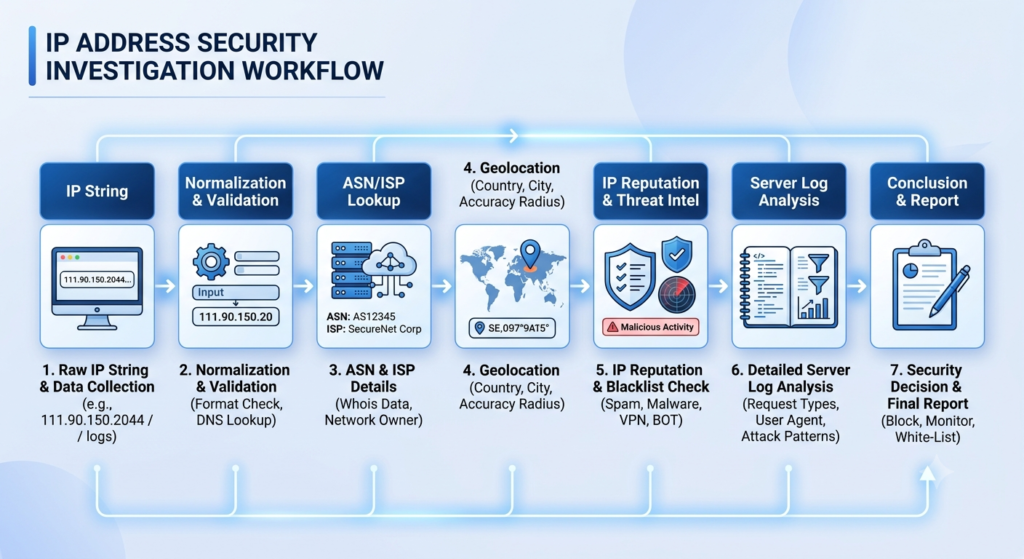
A basic IP investigation can follow this workflow.
Step 1: Normalize the IP
Convert:
111.09.150.182
to the conventional form:
111.9.150.182
Keep the original string in your investigation notes if it came from an application or log.
Step 2: Check Registration and Network Data
Use an IP intelligence service to examine the address range, ASN, ISP, and routing information.
For this address, IPinfo currently associates the normalized IP with the 111.9.150.0/24 range and AS9808.
Step 3: Compare Geolocation Sources
Do not assume that one geolocation database is always correct.
Different providers can produce different city or regional results because they use different datasets and methodologies. MaxMind notes that geolocation accuracy varies and that discrepancies between providers are normal.
Step 4: Check Security Reputation
If you are investigating suspicious traffic, consult reputable threat-intelligence or abuse-reporting databases.
A reputation result should be treated as evidence to investigate, not as an automatic verdict.
Step 5: Review Your Own Logs
Your own server logs may provide more useful evidence than a generic IP lookup.
Compare the address against:
- Request timestamps
- URLs
- Authentication events
- HTTP status codes
- User agents
- Rate limits
- Other related IP addresses
IP Addresses, VPNs, and Proxies
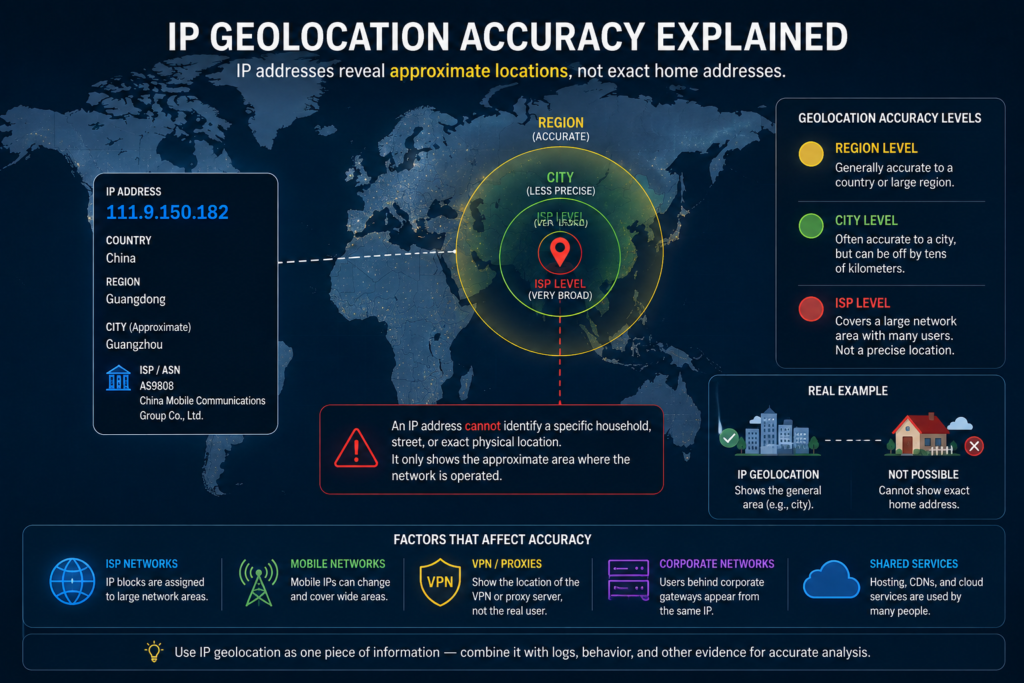
IP location becomes even less reliable when a VPN, proxy, corporate gateway, or privacy network is involved.
For example, someone in one country may connect through a VPN server located in another. An IP database can correctly identify the VPN server’s location while still providing little information about the end user’s actual location.
Mobile networks create another complication. The same public address can potentially be used by different customers or associated with a broader geographic region.
MaxMind identifies mobile networks, proxies, VPNs, and corporate infrastructure among the factors that can reduce the usefulness of granular IP geolocation.
What About Streaming Links and Search Queries?
If you encountered 111.09.150.182 alongside a streaming-related search query, do not automatically assume that the IP hosts the content mentioned in the query.
Search results, advertisements, redirects, embedded resources, CDN requests, tracking systems, and third-party services can create connections that are not obvious from the visible webpage.
For link-security investigations, examine the actual domain, HTTPS certificate, redirect chain, downloaded files, and browser behavior rather than relying solely on an IP address.
An IP can be associated with infrastructure without being the final destination that a user intended to visit.
Technical & Actionable: “Before you block this connection, check its validity and threat level. [Read More: 111.90.150.2044: Is It a Real IP Address or a Security Threat?]“ |
Common Mistakes When Investigating an IP
Assuming an IP equals a person
An IP identifies a network endpoint or address allocation, not necessarily a unique human being.
Treating geolocation as GPS
IP geolocation provides an estimate. It does not normally provide a person’s precise physical position.
Calling an IP malicious without evidence
An unfamiliar address is not automatically a threat.
Ignoring normalization
The difference between 111.09.150.182 and 111.9.150.182 matters when software parses or compares IP addresses.
Relying on one database
IP intelligence changes, and providers may disagree. Compare sources when an investigation has meaningful security consequences.
Practical Security Recommendations
If you are concerned about traffic associated with this address, consider these steps:
- Review the surrounding server or firewall events.
- Normalize IP addresses before applying security rules.
- Check multiple reputable intelligence sources.
- Rate-limit suspicious automated requests.
- Protect login and administrative endpoints with appropriate controls.
- Keep web applications and server software updated.
- Use HTTPS and secure authentication practices.
- Block an address only when its behavior and risk justify doing so.
- Preserve relevant logs before changing firewall rules.
- Monitor for repeated activity from related network ranges.
For website owners, behavioral evidence is usually more useful than a simple geographic label.
Bottom Line
111.09.150.182 should be treated carefully because its formatting is non-standard. For conventional IPv4 analysis, investigate the normalized address 111.9.150.182.
Current IPinfo range data places that address in the 111.9.150.0/24 range associated with AS9808 / China Mobile Communications Group Co., Ltd.
That information does not establish that the IP is dangerous, nor does it identify a particular person or exact physical address.
If you found the address in your logs, the best next step is to combine IP lookup data with timestamps, request behavior, authentication events, DNS information, reputation data, and other network evidence. That produces a much more reliable security assessment than the IP number alone.
For additional network investigations, you can use Midsbyte and its security resources.
FAQ Section
What is 111.09.150.182?
111.09.150.182 resembles an IPv4 address, but its 09 octet is not the standard dotted-decimal representation. For conventional lookup purposes, it should be checked as 111.9.150.182.
Is 111.09.150.182 a real IP address?
The exact textual form is non-standard. The normalized address 111.9.150.182 is part of a currently documented IPv4 range. IPinfo lists it within 111.9.150.0/24.
What is the 111.09.150.182 location?
Current range information associates the normalized address with China Mobile’s AS9808 network. IP geolocation should not be interpreted as an exact physical location.
Is 111.09.150.182 dangerous?
The IP address alone does not establish malicious activity. Security risk should be assessed using traffic behavior, reputation information, logs, and other evidence.
Can an IP address reveal someone’s home address?
Normally, no. IP geolocation is generally approximate and is not sufficiently precise to identify a specific household or street address.
Why can IP lookup services show different locations?
Different providers use different datasets and methods. VPNs, mobile networks, ISP reassignment, and network infrastructure can also cause discrepancies.
Should I block 111.9.150.182?
Not solely because it appears in a log. First determine whether the traffic is genuinely suspicious. If there are repeated attacks, abusive requests, or other clear indicators, blocking or rate-limiting may be appropriate.
Why does the leading zero matter?
Different software can interpret unusual IP representations differently. RFC 3986 warns that alternative IP formats can create security problems when applications use textual IP comparisons for filtering.
About the Author
Ruth Blair is a cybersecurity researcher and technical writer specializing in network diagnostics, WHOIS intelligence, and threat telemetry. With a background in systems analysis, Ruth translates complex IP routing data, server logs, and security infrastructure into actionable insights for webmasters and network administrators. When not analyzing network traffic, she focuses on making web security accessible to everyday internet users.