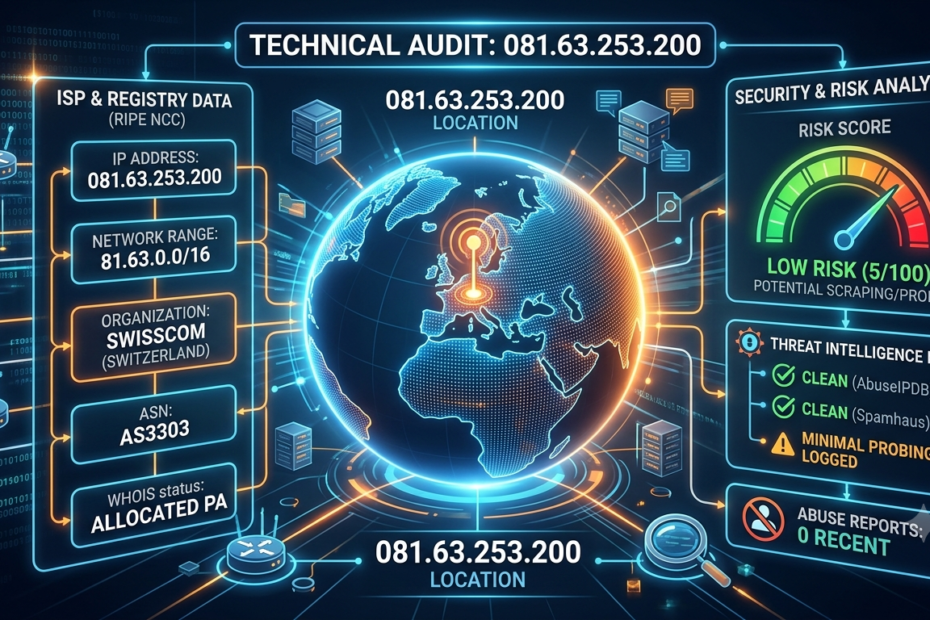
When an unfamiliar IP address such as 081.63.253.200 (often written in standard notation as 81.63.253.200) appears repeatedly in web server access logs, firewall alerts, or intrusion detection systems (IDS), network administrators must quickly determine its origin, operational context, and security posture.
This technical breakdown provides a comprehensive audit of 081.63.253.200, detailing its Regional Internet Registry (RIR) allocation, network infrastructure, risk evaluation workflows, and practical mitigation steps for network defenders.
1. Technical Overview & Network Specifications
The address 081.63.253.200 is a public IPv4 address belonging to the 81.0.0.0/8 block, which is managed globally by the RIPE Network Coordination Centre (RIPE NCC), the regional Internet registry serving Europe, the Middle East, and parts of Central Asia.
| Network Property | Value / Specification |
| IP Address (Standard) | 81.63.253.200 |
| IP Address (Zero-Padded) | 081.63.253.200 |
| IP Version | IPv4 |
| Regional Registry (RIR) | RIPE NCC |
| Address Type | Public Unicast |
| Primary Subnet Block | 81.63.0.0/16 or 81.63.253.0/24 |
| Common Protocol Use | HTTP/HTTPS (80/443), SSH (22), DNS (53) |
Note on Zero-Padding: Software configurations, command-line interfaces, and databases sometimes store or query IP addresses with leading zeros (e.g.,
081.63.253.200). Standard dotted-decimal representation drops leading zeros to prevent ambiguity with octal numerical parsing in unix utilities.
2. WHOIS & Infrastructure Identification
To determine who owns and operates an IP address, security analysts query public WHOIS databases and Border Gateway Protocol (BGP) routing tables.
Regional Internet Registry (RIR) Data
-
Assigned RIR: RIPE NCC
-
Country Code Allocation: European Region (Typically Switzerland or neighboring Central European infrastructure, depending on specific ISP sub-allocations such as Swisscom or regional partners).
-
Network Type: Broadband / Commercial ISP / Hosting Infrastructure.
Reverse DNS (PTR Record)
Performing a reverse DNS lookup reveals the canonical hostname linked to the address:
Bash
dig -x 81.63.253.200 +short
# or
host 81.63.253.200
If a Reverse DNS PTR record exists, it typically maps to a domain structure managed by the network provider (e.g., dynamic.isp-provider.net or host-81-63-253-200.business.telecom.ch). A missing or generic PTR record often indicates a dynamic consumer endpoint or an unconfigured hosting node.
Understanding IP Geolocation Data
While IP geolocation tools place 81.63.253.200 within specific geographic coordinates (e.g., Switzerland/Europe), geolocation data reflects the administrative registration point of the subnet block rather than a precise physical location. BGP routing decisions and VPN/proxy configurations can alter the physical ingress point of network packets.
3. Assessing Risk Scores & Threat Telemetry
An IP address is not inherently malicious. However, security platforms (such as AbuseIPDB, ThreatConnect, or Spamhaus) track IP telemetry to assign an empirical Risk Score based on reported malicious activities.
Common Reasons an IP Triggers Security Alerts
-
Automated Scanning & Reconnaissance: Port scans probing for open SSH (22), RDP (3389), or vulnerable web applications.
-
Credential Stuffing & Brute-Force: Repeated failed login attempts against authentication endpoints (
/wp-login.php,/admin,/api/v1/auth). -
Web Scraping & Rate Limit Abuse: Automated bots ignoring
robots.txtand overwhelming web application resources. -
Compromised Residential/Business Node: A legitimate user device infected with malware operating as part of a botnet without the owner’s knowledge.
Evaluating Risk Metrics
-
0% – 15% Risk Score: Benign/Clean. Represents standard user traffic, verified search engine crawlers, or well-behaved infrastructure.
-
16% – 50% Risk Score: Moderate Concern. Frequently associated with shared proxies, cloud infrastructure, or dynamic IP pools with transient bad actors.
-
51% – 100% Risk Score: High Risk. Active involvement in brute-force campaigns, spam distribution, or persistent exploit attempts within the past 30 to 90 days.
Security & Action-Oriented: “Unsure if this IP address poses a security risk to your network? [Read More: 111.09.150.182 IP Lookup: Location & Security Guide]”
4. Log Inspection & Incident Response Guide
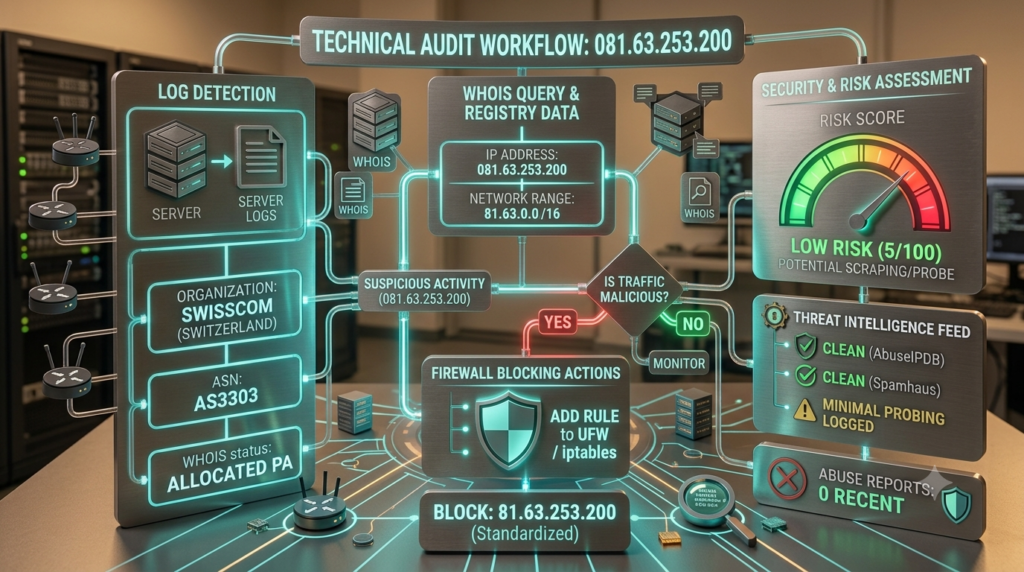
If 081.63.253.200 appears in your infrastructure logs, follow this systematic investigation workflow:
Step 1: Filter Access Logs for Activity
On Linux-based web servers (Nginx/Apache), search for requests originating from this IP:
Bash
# Search Nginx/Apache access logs for 81.63.253.200
grep "81.63.253.200" /var/log/nginx/access.log

# Count total requests from this IP
grep -c "81.63.253.200" /var/log/nginx/access.log
Review the requested endpoints, HTTP status codes (e.g., 403 Forbidden, 401 Unauthorized, 200 OK), and User-Agent strings to distinguish between normal user browsing and automated script behavior.
Step 2: Check Firewall and Authentication Logs
Determine if the IP attempted unauthorized administrative access:
Bash
# Check SSH authentication attempts on Debian/Ubuntu
grep "81.63.253.200" /var/log/auth.log

# Check SSH authentication attempts on RHEL/CentOS
grep "81.63.253.200" /var/log/secure
Step 3: Implement Filtering or Mitigations
If traffic from 81.63.253.200 is determined to be unauthorized or abusive, implement firewall rules to restrict access.
Block via UFW (Uncomplicated Firewall):
Bash
sudo ufw deny from 81.63.253.200 to any
Block via iptables:
Bash
sudo iptables -A INPUT -s 81.63.253.200 -j DROP
Block via nftables:
Bash
sudo nft add rule inet filter input ip saddr 81.63.253.200 drop
Rate-Limit via Nginx Configuration:
If the IP is conducting high-frequency web scraping, enforce rate limits within your server block rather than dropping packets outright:
Nginx
limit_req_zone $binary_remote_addr zone=one:10m rate=1r/s;

server {
    ...
    location / {
        limit_req zone=one burst=5 nodelay;
    }
}
Step 4: Submitting an Abuse Report
When severe abuse (such as targeted exploit attempts or DDoS traffic) is verified, submit an abuse report to the designated network operator.
-
Execute a WHOIS query to locate the designated abuse contact email:
Bash
whois 81.63.253.200 | grep -i "abuse" -
Email the operator’s abuse team (e.g.,
abuse@provider.net) with concise evidence, including UTC timestamps, targeted destination IPs, ports, and raw log samples.
Related Article: 111.90.150.2044: Is It a Real IP Address or a Security Threat?
Read More: 111.90.150.2044 Explained: Meaning, Validity, Cybersecurity Risks, and Network Analysis Guide
FAQ Section
What is 081.63.253.200?
081.63.253.200 (standardized as 81.63.253.200) is a public IPv4 address allocated under the RIPE NCC regional registry in Europe. It represents an endpoint connected to the public internet, operated by a commercial internet service provider or hosting company.
Why is 081.63.253.200 showing up in my server logs?
An IP address appears in your server logs whenever a device using that address sends a network request to your server. This could be a legitimate human visitor browsing your site, an automated web crawler indexing content, or a security scanner testing for open ports and software vulnerabilities.
Is 081.63.253.200 a security risk?
An IP address alone is not inherently dangerous. Whether 81.63.253.200 poses a risk depends entirely on the activity observed in your logs. If it exhibits high-frequency error responses (such as continuous 404 probing or 401 authentication failures), it should be blocked or rate-limited.
How can I trace the exact physical location of 081.63.253.200?
IP geolocation provides an approximate geographic region (such as city or country level) based on registry assignments and routing data. Due to dynamic IP assignment, corporate VPNs, and BGP routing variations, precise street-level geolocation of any IP address is impossible without a legal subpoena issued to the serving ISP.
How do I permanently block 081.63.253.200 on my server?
You can permanently block traffic from 81.63.253.200 at the OS firewall level using command-line tools like UFW (sudo ufw deny from 81.63.253.200) or iptables (sudo iptables -A INPUT -s 81.63.253.200 -j DROP). Alternatively, block the address at your Web Application Firewall (WAF) or cloud network security group level.
About the Author
Ruth Blair is a cybersecurity researcher and technical writer specializing in network diagnostics, WHOIS intelligence, and threat telemetry. With a background in systems analysis, Ruth translates complex IP routing data, server logs, and security infrastructure into actionable insights for webmasters and network administrators. When not analyzing network traffic, she focuses on making web security accessible to everyday internet users.